
The Fayetteville-Manlius Central School District is building on its work to prepare students for success beyond graduation as New York State outlines the next phase of NY Inspires, its initiative to transform graduation requirements and expand how students demonstrate their learning.
During the Sept. 14 Board of Regents meeting, the New York State Education Department presented plans to move to one state high school diploma and end the requirement that students pass Regents examinations to graduate. Regents examinations would remain available as one resource that measures students’ understanding of state learning standards. Read the September Board of Regents memo.
Under the September proposal, those changes would begin in the 2027-28 school year and apply to students graduating in January 2028 or later. A single New York State diploma would replace the current diploma types, with seals and endorsements recognizing additional achievements.
The state also outlined a broader approach to understanding student progress through local assessment strategies that draw on multiple sources of student learning. The specific framework for these strategies has not yet been presented to or approved by the Board of Regents. A proposal is not expected until February 2027, and Fayetteville-Manlius, along with districts across New York state, is awaiting further guidance from the New York State Education Department. View the state’s presentation.
Many of the practices that could support this approach already exist in Fayetteville-Manlius classrooms. The district is considering how that work could fit within the state’s eventual framework as more details become available.
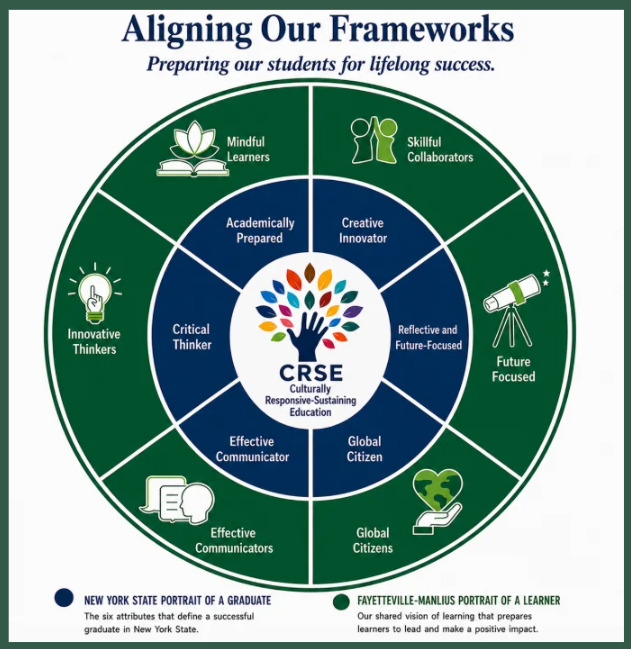
At Fayetteville-Manlius, preparation includes developing a shared understanding of the skills students should build throughout their education.
The district’s K-12 Portrait of a Learner aligns with the New York State Portrait of a Graduate, the anchor of NY Inspires. The portrait identifies six attributes for all NY graduates: Innovative Thinkers, Skillful Collaborators, Future Ready Scholars, Global Citizens, Mindful Learners and Effective Communicators. Similar to the New York State Portrait of a Graduate, Culturally Responsive-Sustaining Education is at the center of the F-M portrait.
These attributes connect academic learning with skills students can apply beyond the classroom. Supporting materials describe how the attributes develop across grade levels and include questions families can use to discuss learning with their children. For example, families can ask what sparked a student’s curiosity or how they responded to someone with a different perspective.
The District Curriculum Council spent the past year helping develop Fayetteville-Manlius’ portrait. Student creativity also contributed to its visual identity, with Fayetteville-Manlius High School junior Kira Coleman designing graphics representing the six attributes.
Students have participated in conversations about what meaningful learning looks like. Through the Fayetteville-Manlius High School Student Forum, students explored personalized learning and considered how Portrait of a Learner skills connected to memorable classroom experiences. They also discussed what they would like to see in their classes.
Fayetteville-Manlius shared this work during its March 2026 NY Inspires presentation to the Board of Education and community, which was also presented to Parent Council that month. The presentation highlighted opportunities for students to pursue their interests through career and technical education and dual credit courses. It also featured community connections, including Micron Chip Camp, Manlius art installations and internships. View F-M’s March presentation.
Professional learning has supported the district’s preparation. Curriculum, instruction and assessment newsletters have shared classroom examples of personalized learning, including opportunities for students to make choices about their projects and reflect on their progress.
Middle and high school teachers also shared examples of personalized learning that highlighted Portrait of a Learner skills during the High School Instructional Forum and monthly faculty meetings. These presentations gave colleagues opportunities to explore instructional approaches and resources, including classroom projects that helped students practice those skills.
That work continued during the district’s May 2026 professional development day, when more than 200 faculty members participated in NY Inspires sessions led by District Curriculum Council members.
Although Fayetteville-Manlius introduced its Portrait of a Learner to the public in March, in the coming months the district will share more information to help students and families become familiar with its attributes and their connections to classroom learning. The district will also provide updates about proposed assessment changes as the state releases further guidance.
As the district moves F-M Forward, this work builds on learning experiences already taking place in its schools and supports students in developing the knowledge and skills they will use beyond graduation.